Before you arrive
When you ring, say you’re nervous and roughly how long it’s been. If you’d like a chat before anything else happens, ask for that too.

If you’ve had our number up on your phone three times this month and hung up before it rang, you’re not alone. When you do call, “I’m nervous” is a perfectly good first sentence. It’s enough for us to slow everything down, explain each step before we do it, and stop the moment you raise your hand.
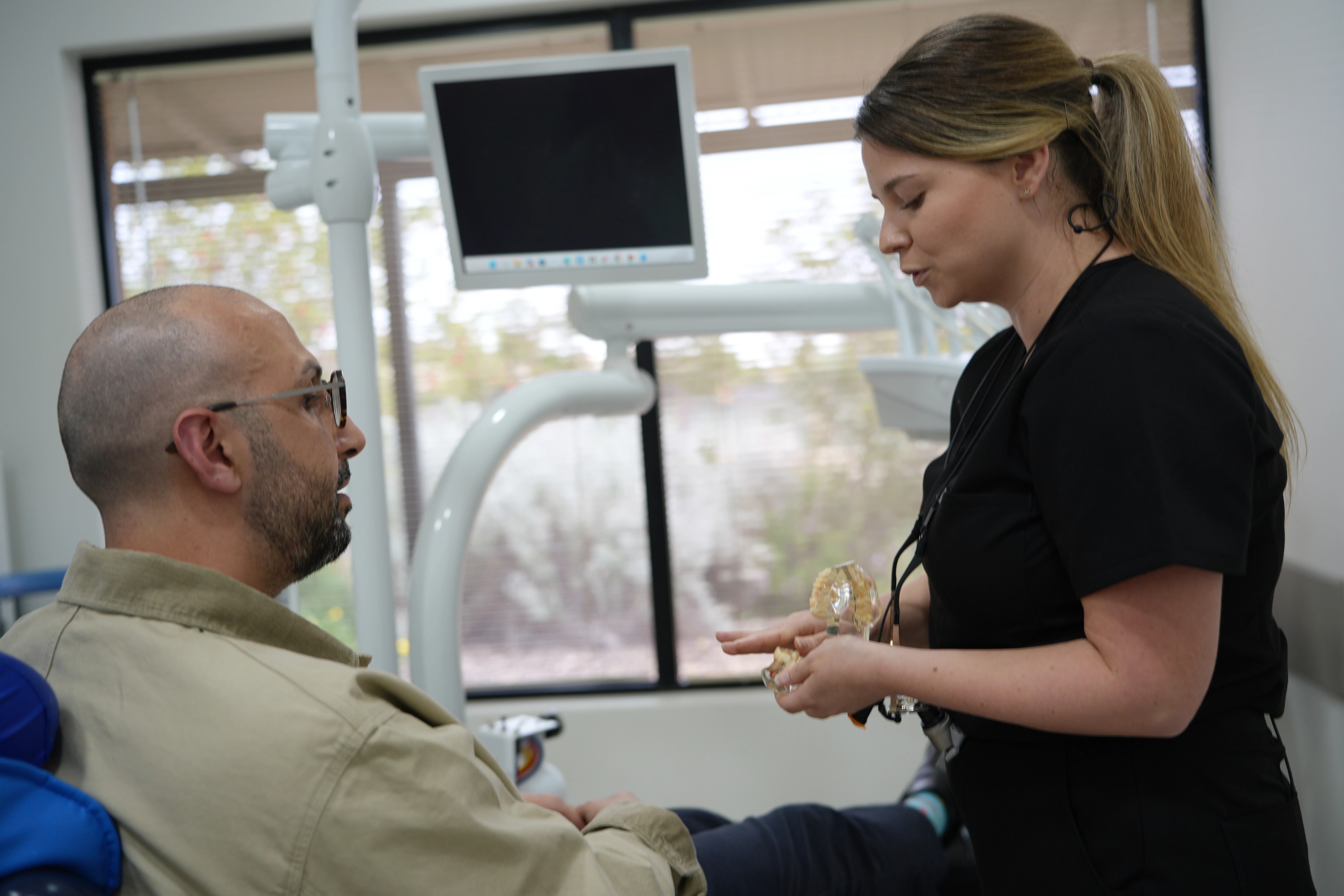
For some people it’s the needle. For others it’s the noise, the smell, lying back with someone leaning over them, or one visit years ago that went badly. Whichever it is for you, naming it gives us something real to plan around.
When you ring, say you’re nervous and roughly how long it’s been. If you’d like a chat before anything else happens, ask for that too.
Sounds, needles, a strong gag reflex, past pain, feeling rushed. Let us know which, and we’ll plan around that one.
Before we start, we’ll settle on how you’ll signal a break, usually a raised hand. Your dentist explains each step before doing it, so nothing comes out of nowhere.
Bring a list of your medicines and health conditions. It matters for numbing, and even more if sedation comes up.
Pick the one closest to where you are right now. Saying it when you ring helps us book the right kind of visit, with enough time for it.

Before the visit, let us know what’s been hard and how much detail you want. Some people like every step described; others would rather just hear when it’s nearly over. In the chair, your dentist says what they’re about to check before they check it, what they found, and what they’d suggest next.
Think about what would help: a raised hand for a break, a pause for questions, or two short visits instead of one long one. If sedation comes up, your dentist will go through what it involves before anything is booked.
Jot your questions in your phone and read them out when you ring. Nobody minds.

This is the usual order. You can stop it at any step with the signal you’ve settled on, and pick it up again when you’re ready.
Mention what’s been hard before, and whether you’d like each step described before it happens.
A raised hand is the usual one. Use it for pain, for nerves, or just because you have a question.
You talk first. Then your dentist goes over your history, checks your mouth and explains what they see, with X-rays only if they’re needed.
Your dentist sorts what needs doing first from what can be spread over later visits, and whether sedation would help with the bigger jobs.
Your dentist will explain the options. These are worth asking as well, and none of them is a silly question.
Call (08) 9407 7888Some things are easier to say out loud than to type into a booking form. If that’s you, call (08) 9407 7888 before you book, and we’ll take it from there.
Nerves rarely turn up on their own. Often there’s pain as well, an overdue check-up, a smile you’ve started hiding, or just not knowing what a first visit involves.
You might also want to read
You might also want to read
You might also want to read
You might also want to read
What to say on the phone, whether you can stop, what sedation involves, and what changes if something hurts.
Just say you’re anxious. If you can, add the part that worries you most: a bad visit before, fear of pain, needles or the noise, embarrassment about how long it’s been, a strong gag reflex, or needing each step explained. One sentence is plenty, and it doesn’t have to come out neatly.
Mention any pain, swelling or broken tooth too, so we book the right kind of appointment. On the day, your dentist will explain each step before doing it, and you’ll settle on a signal for when you need a pause.
It can start that way. Say when you book that nerves are part of the reason, and ask for time to talk before anyone picks up an instrument. Your dentist will still want a look in your mouth to give you useful advice, and will explain what they see as they go.
Nothing has to be decided on the day. Your dentist will say which decisions belong at this visit and which can be made later. You’re welcome to see Dr Maddi Sheppard, whose work centres on nervous patients and children. If something hurts, say so, so the booking covers the tooth as well as the nerves.
Two kinds can be considered for some treatment: oral sedation, taken as a tablet, and IV sedation, given through a vein. “Sleep dentistry” is a loose term, so don’t assume it means being fully unconscious. Share your full medical history first. Then ask who the provider is and who’ll look after you while you’re sedated, how aware you’ll be, and how long to fast first. It can be up to 8 hours. Your dentist will go through the rest of the preparation and aftercare with you. You’ll need someone to drive you home, and you can’t drive for the rest of the day.
If sedation doesn’t suit your health or the planned care, we’ll discuss another way forward together.
You can. Before starting, you and your dentist settle on a signal, usually a raised hand, and when you use it, they stop. It works for pain, for worry, or for a question.
If it all gets too much, say so. You can carry on more slowly, change the plan, come back another day, or ask about sedation for next time.
When you ring, just say it: you’ve put it off and you’re worried about being judged. That’s all we need to hear. What actually helps is knowing what’s changed lately, whether that’s pain, bleeding, a broken tooth, sensitivity, a loose denture or how your teeth look.
At the visit, your dentist checks your teeth, gums, bite and mouth and explains what they find in everyday words. You’ll hear what needs attention first, what can be watched, and what the next visit would involve. The gap is just where we start from. It’s never a reason to stay away when something hurts.
Write down three things you want your dentist to know: what sets the anxiety off, what helps you feel in control, and any tooth or gum problem that’s bothering you. Bring your medical history, a list of medicines, and any questions about cost, timing or sedation.
healthdirect recommends letting your dental team know you’re nervous, so ring ahead if you’d like to explain more. If pain, swelling or an injury has turned up since you booked, mention that too. The clearer the picture, the more the visit can be about what matters to you.